Daily Dev Tracker
A minimal and sleek daily developer productivity tracker.
Project maintained by devil-1964 Hosted on GitHub Pages — Theme by mattgraham
Day 1 - Azure Learning Plan
Cloud Fundamentals
Introduction to Cloud Computing
- Definition and benefits of cloud computing A service that is available over the internet, allowing users to access computing resources on-demand.
Types of Cloud Deployments
- Private Cloud: Cloud infrastructure operated solely for a single organization.
- Maintaining control over data and security.
- Customization to meet specific business needs.
- Public Cloud: Cloud services offered over the public internet and available to anyone.
- Cost-effective and scalable.
- Managed by third-party providers.
- Scale without changing underlying infrastructure.
- can access resources from anywhere with an internet connection.
- cost saving because cloud services are shared between multiple users.
- Hybrid Cloud: A combination of private and public clouds, allowing data and applications to be shared between them.
- Flexibility to choose optimal deployment for each workload.
- Enhanced security for sensitive data.
- Cost efficiency by leveraging public cloud resources when needed.
- Cons complexity in management and integration.
Compare capex and opex in different cloud models.
- Capital Expenditure (CapEx): Upfront costs for physical hardware and infrastructure in traditional IT setups.
- Operational Expenditure (OpEx): Ongoing costs for cloud services, typically billed based on usage, allowing for more predictable budgeting and reduced upfront investment.
Consumption-based pricing model: Pay only for the resources you use, allowing for cost efficiency and scalability, better cost prediction, and reduced upfront investment.
Cloud Service Models
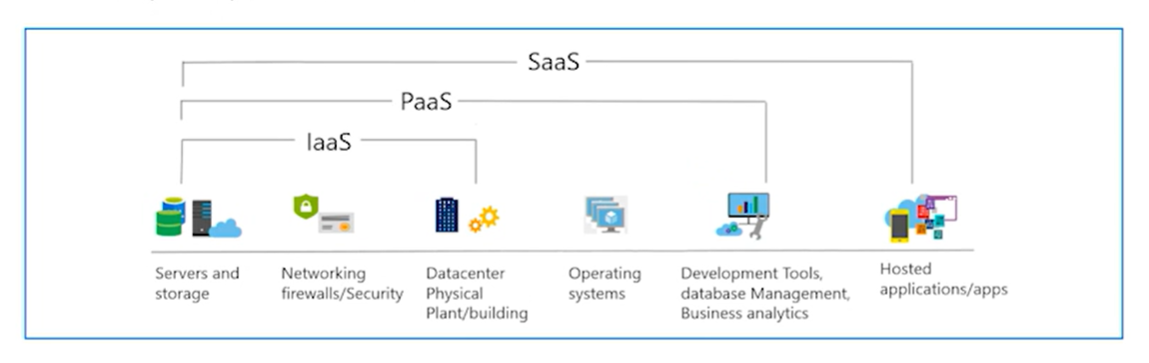
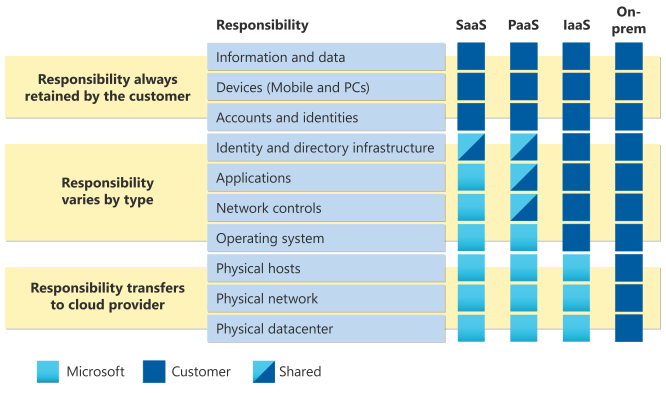
- Types of cloud services: IaaS, PaaS, SaaS
- IaaS (Infrastructure as a Service): Provides virtualized computing resources over the internet. Most flexible
- PaaS (Platform as a Service): Provides a platform allowing customers to develop, run, and manage applications. Focus on application development without worrying about underlying infrastructure.
- SaaS (Software as a Service): Delivers software applications over the internet, on a subscription basis. Pay as you go model, ready to use applications.
Cloud Benifits
- High Availability
- Elasticity
- Scalability
- vertical scaling - adding more power (CPU, RAM) to an existing machine.
- horizontal scaling - adding more machines to handle increased load.
- Reliability
- Predicibility
- Security
- Governance - policies and rules to manage cloud resources effectively, production standards, compliance, and cost management.
- Managability
Related Concepts
-
Virtualization: Creating virtual versions of resources like servers or storage to maximize hardware use.
Example: Running several virtual servers on one physical machine. -
Hypervisor: Software that enables virtualization by running and managing virtual machines.
Example: VMware ESXi, Microsoft Hyper-V. -
API (Application Programming Interface): A set of rules for software to communicate and interact.
Example: Using REST APIs to automate cloud resource management. -
Regions: Physical locations around the world where cloud providers host data centers.
Example: Azure “East US” or “West Europe”. -
Availability Zones: Separate, isolated locations within a region for higher redundancy and reliability.
Example: Deploying resources across zones to ensure uptime if one fails. -
Scalability: The ability to grow or shrink resources to meet demand.
Example: Adding servers during peak usage. -
Elasticity: Automatically adjusting resources based on real-time demand.
Example: Auto-scaling web servers up or down as traffic changes. -
High Availability: Designing systems to minimize downtime and ensure continuous service.
Example: Using redundant servers and load balancers. -
Disaster Recovery: Plans and tools to restore data and services after failures or disasters.
Example: Backing up data to another region for quick recovery. -
Agility: Rapidly adapting to changes and deploying new solutions.
Example: Rolling out new app features in hours instead of weeks.